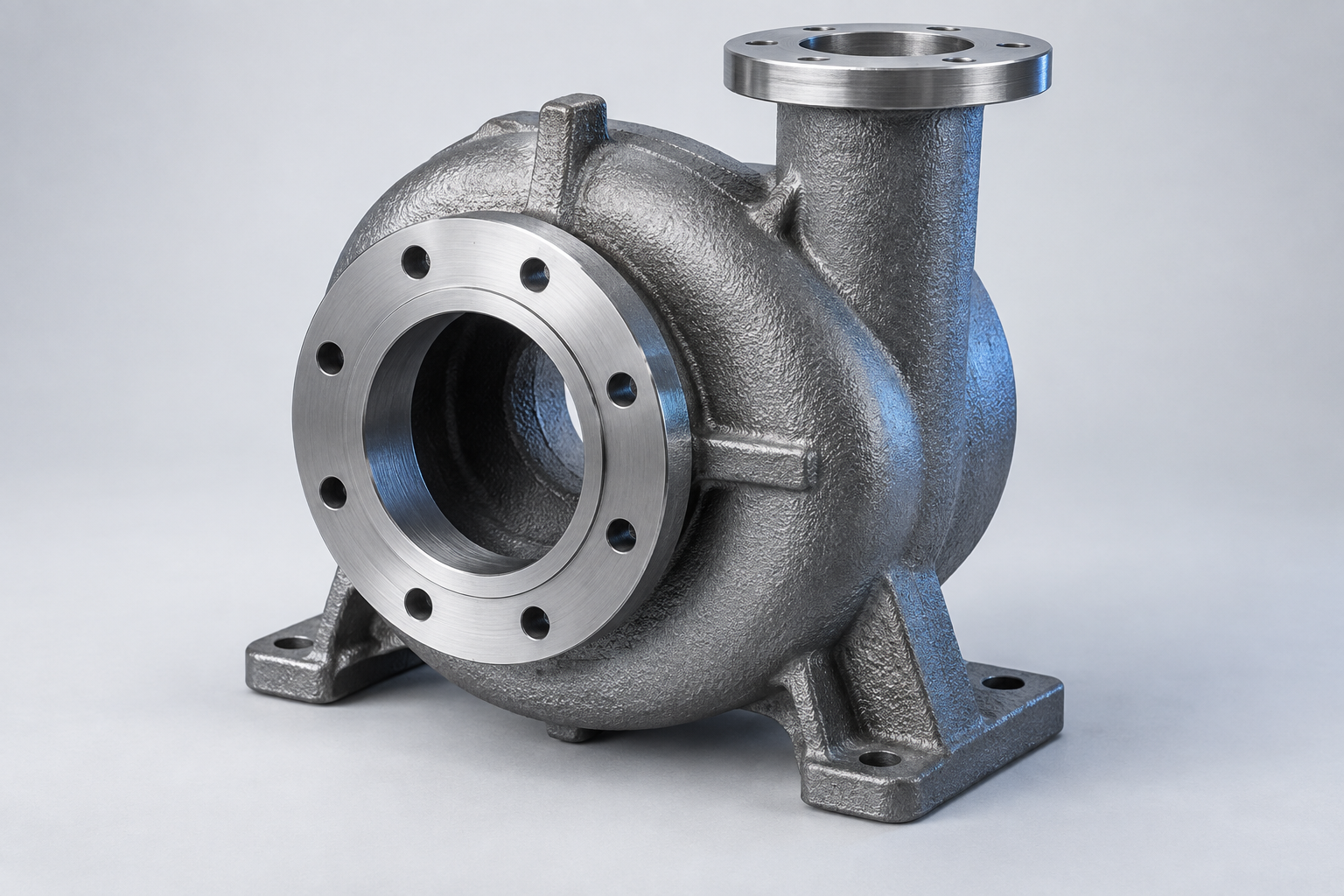
Our independent manufacturing network supports sand and investment casting, with cast-steel, cast-iron, aluminum and stainless-steel options matched to the application. For suitable geometries, 3D-printed sand molds can support prototype work and shorter mold lead times.
When a part needs more than an as-cast blank or standard rough machining, we coordinate high-precision machining, heat treatment, surface finishing and specified inspection across the network. This joins casting with the work needed to finish functional bores, sealing faces, mounting points and other critical interfaces.
Casting support
Material choices
Cast steel, cast iron, aluminum and stainless steel options matched to the application.
3D-printed sand molds
For suitable geometries, printed sand molds support fast-turnaround prototypes and early production.
High-precision follow-up work
Coordinate machining, heat treatment, surface finishing and specified inspection for critical interfaces.
Casting methods
We offer the following casting methods. Choose by part size, geometry, material, production volume and finish; alloy fit varies by route.
01
Sand casting
A sand mold and optional cores form the casting cavity; molding can be manual or automated.
Advantages
Flexible for complex shapes and a broad range of part sizes, with lower tooling commitment than a permanent die. Cores form internal passages.
Materials
Cast iron, cast steel and selected aluminum alloys.
Typical parts
Large machine bases, pump and valve bodies, housings, manifolds and structural castings.
Choose when
The part is large or heavy, especially in iron or steel, or a lower-volume program needs a cored shape.
02
3D-printed sand molds
Sand molds or cores are printed from digital geometry; the metal component is still produced by conventional casting.
Advantages
Avoids pattern or core-box lead time for suitable parts and makes complex internal geometry easier to trial.
Materials
Iron, steel or aluminum casting alloys, subject to the selected foundry route.
Typical parts
Prototype housings, manifolds, pump or valve components and low-volume castings with complex cores.
Choose when
A prototype, design iteration or fast-turnaround part would be delayed by conventional pattern tooling.
03
Investment casting
A ceramic shell formed around a disposable wax pattern captures detailed contours and integrated features.
Advantages
Fine detail and near-net geometry can reduce machining on noncritical surfaces.
Materials
Selected cast stainless, carbon and alloy steels, aluminum, copper-based and nickel alloys.
Typical parts
Impellers, valve components, levers, brackets and compact flow-control parts.
Choose when
A small or medium complex part has thin sections, curves or details that are difficult to form by another casting route.
04
Shell molding
Resin-coated sand forms a thin, rigid shell against a heated pattern; automatic molding can support repeat production.
Advantages
A stable mold can improve surface detail and dimensional consistency over general sand molding for suitable parts.
Materials
Cast iron and selected cast carbon or alloy steels.
Typical parts
Small-to-medium gear housings, pump or valve components, brackets and repeat industrial parts.
Choose when
A repeat program needs more surface detail or consistency than general sand molding and justifies a dedicated pattern.
05
Centrifugal casting
A rotating cylindrical mold distributes molten metal against the mold wall to form a hollow, rotationally symmetric part.
Advantages
Forms the hollow bore without a long internal core and suits tubular or ring-shaped geometry.
Materials
Cast iron, carbon, alloy or stainless steel, and selected nonferrous alloys.
Typical parts
Pipes, sleeves, liners, bushings, rings and other tubular components.
Choose when
The part is principally cylindrical or axisymmetric and the bore and outside diameter can be finished to the drawing.
06
Low-pressure die casting (LPDC)
Controlled low pressure feeds molten aluminum upward from a furnace into a reusable die.
Advantages
Controlled filling reduces turbulence and supports feeding, helping produce sound castings.
Materials
Aluminum casting alloys.
Typical parts
Alloy wheels, compressor wheels, heat sinks and selected equipment housings.
Choose when
An aluminum part prioritizes internal soundness, mechanical properties or heat-treatment requirements, and repeat volume justifies reusable-die tooling.
07
High-pressure die casting (HPDC)
Molten alloy is injected rapidly under high pressure into a reusable metal die.
Advantages
Short cycles, repeatable detail and thin-wall shapes for production volumes.
Materials
Commonly aluminum, zinc and magnesium alloys; not a steel or iron casting route.
Typical parts
Motor or electronics housings, covers, brackets, connectors and other repeat components.
Choose when
A thin-wall nonferrous part has repeat demand that justifies the die investment and a high-rate process.
Materials
Material options cover cast parts, follow-on machining and related components across the manufacturing network.
Aluminum alloys
Wrought stock grades; A356.0 is a casting alloy and MIC-6 is cast tooling plate.
2024
5052
6061
6063
6082
7050
7075
A356.0 — Casting alloy
MIC-6 — Cast tooling plate
Carbon steels
Machining-stock grades.
SAE 1018
SAE 1020
SAE 1045
SAE 1215
ASTM A36
Alloy steels
Machining-stock grades.
SAE 4130
SAE 4140 / 4140 PH (pre-hardened)
SAE 4340
42CrMo
Tool steels
Machining-stock grades.
A2
O1
Stainless steels
Wrought stainless families; cast stainless grades are listed separately below.
300 series — 304 · 316 / 316L
400 series — 410 · 416 · 420 · 440C
15-5 PH
17-4 PH
18-8 — General designation; exact grade by drawing