
Forged components
Available partner capability includes nine die-forging production lines with 300–4,000 t presses, including electric screw, servo-driven electric screw and hot-die forging presses.
AMES / MANUFACTURING CAPABILITY
Forged steel and stainless-steel components with coordinated heat treatment, CNC machining and surface finishing.
Discuss your part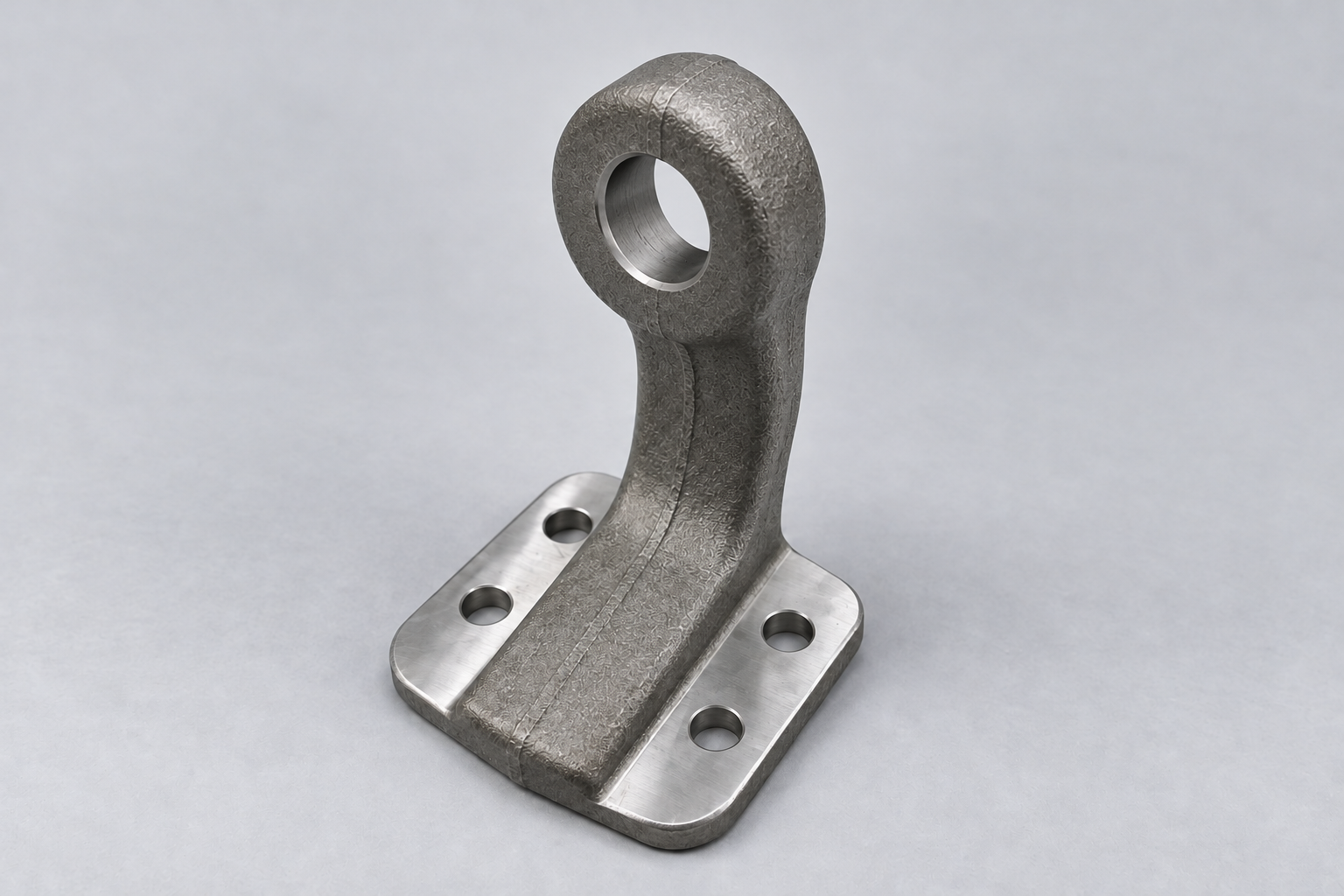
AMES coordinates steel and stainless-steel forgings for bearing rings, shafts, hubs, clevises, yokes, load-bearing brackets and hinge components that must carry high loads or withstand repeated stress and impact. Forging shapes solid metal stock with compressive force; the workpiece is not melted and poured. With suitable material and process design, forging can guide grain flow along a part’s form. Specified heat treatment, CNC machining and surface finishing are coordinated through independent manufacturing partners.
Available partner capability includes nine die-forging production lines with 300–4,000 t presses, including electric screw, servo-driven electric screw and hot-die forging presses.
Specified annealing, normalizing, quench-and-temper and stress-relief cycles use controlled-atmosphere, isothermal-normalizing, and vacuum gas-quenching and tempering equipment.
Three-, four- and five-axis machining, with turning, milling and drilling for specified bores, bearing seats, faces and threads.
Coating and other specified finishes are coordinated to the service environment; critical fits can be masked when required.
Temperature is separate from forming method: hot forging works above an alloy’s recrystallization temperature, warm forging uses an intermediate range below it, and cold forging starts at or near room temperature. All are solid-state processes.
A heated, solid billet is compressed between matched dies with shaped impressions. A drop hammer delivers repeated blows (drop forging), while a press closes the dies. Conventional impression-die forging may form flash at the parting line, which is trimmed as specified.
A heated billet is compressed between relatively simple flat, V-shaped or contoured dies that do not enclose it in a full cavity. The stock is turned or repositioned between strokes to build the required form.
A heated round or flat bar passes through opposing rolls with profiled grooves. The rolls reduce and redistribute selected sections while lengthening the stock, producing an elongated shape or a preform for impression-die forging.
Axial compression shortens a bar end or section and increases its cross-section. When the enlarged feature is at the end, the operation is commonly called heading; it can be hot, warm or cold.
A pierced, upset preform is rolled between a driven roll and a mandrel or idler roll. The wall is reduced as the ring expands in diameter, producing a one-piece ring without a welded seam.
Forgeability depends on alloy, stock condition, section size, deformation route and heat treatment.
Final properties depend on reduction, section size and heat treatment.
Forge temperature, work hardening, corrosion needs and post-forge treatment depend on grade.
Match stock form and condition, forging route and final heat treatment to the alloy.
Match alloy and condition to the deformation route.
C37700 forging brass is suitable for hot forging and upsetting, not cold forming.
Forging and heat-treatment practice strongly affect final properties.
Specialized hot-forming equipment and temperature control are required.
Confirm grade, stock condition, forging temperature, section size and heat-treatment sequence against the drawing and selected route.
NEXT STEP