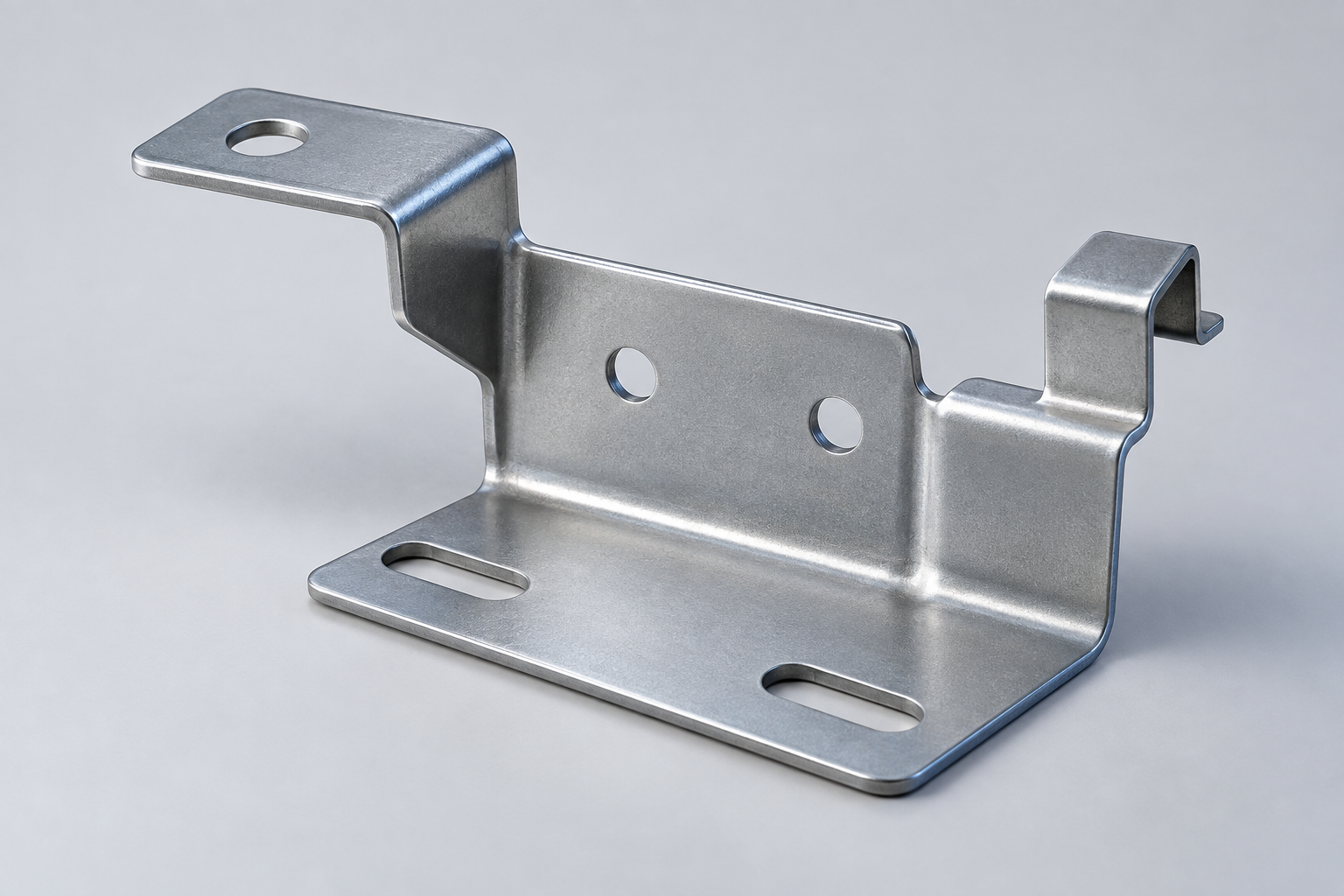
Stamping forms sheet or strip in a press using cutting, bending and drawing operations. The metal stays solid; a progressive die sequences operations along a moving strip. AMES coordinates stamped components through independent manufacturing partners, matching material, thickness, temper, coating, tooling and follow-up work to the drawing and production plan.
Supply options
Stamping routes
Standard and precision stamping for formed metal components.
Deep drawing
Deep drawing for suitable sheet-metal designs.
Typical parts
Typical fit includes brackets, clips, washers, spacers and covers.
Secondary work
Coordinate machining, surface finishing and inspection as specified.
Stamping methods
Choose a stamping route to suit the geometry, material and expected production volume.
01
Blanking and piercing
Punch-and-die tooling shears a flat blank or cuts holes and slots in sheet or strip. Blanking defines the outside profile; piercing makes internal openings.
Advantages
Efficient for flat profiles and repeated openings; the tool sequence can combine cutting with later forming.
Materials
Formable carbon-steel, stainless-steel or aluminum sheet and strip; strength, thickness, coating and tool clearance affect results.
Typical parts
Washers, flat brackets, mounting plates, spacers and pierced component blanks.
Choose when
The main geometry is a flat outline or a controlled pattern of holes and slots.
02
Bending and forming
Punches and dies bend or shape sheet into angles, flanges, hems, offsets, beads and other formed sections without removing material.
Advantages
Creates useful three-dimensional features with direct tooling; multiple bends can be combined in a staged die.
Materials
Carbon-steel, stainless-steel or aluminum sheet selected by thickness, strength, temper, bend radius and rolling direction.
Typical parts
Brackets, clips, covers, guards and formed mounting sections.
Choose when
The part is mostly sheet with bends or shallow formed details and does not need a drawn cup-like shell.
03
Progressive-die stamping
A coil or strip advances through successive die stations that pierce, bend or form features; the finished part is cut free at the final station.
Advantages
Combines repeated operations in one press cycle and supports consistent output after setup; dedicated tooling suits repeat demand.
Materials
Coil-capable carbon steel, stainless steel or aluminum; strip width, thickness, strength, coating and feed direction must suit the die.
Typical parts
Repeat brackets, clips, spacers, small housings and electrical or mechanical components with several features.
Choose when
A repeat program has multiple operations along a strip and expected volume supports progressive tooling.
04
Deep drawing
A punch pushes a sheet blank into a die cavity while a blank holder controls material flow, forming a cup or shell. Deeper parts may need more than one draw stage.
Advantages
Forms an enclosed or cup-shaped part from one piece of sheet, reducing seams and separate-piece assembly for suitable designs.
Materials
Drawing-quality low-carbon sheet, annealed stainless sheet and formable aluminum sheet in a suitable temper.
Typical parts
Cups, sleeves, covers, canisters, housings and shallow reservoirs.
Choose when
The part needs a continuous drawn wall around a cavity instead of a flat blank or a series of bends.
Materials
Sheet form, grade, thickness and temper affect how a material can be cut, bent or drawn.
Zinc-coated drawing-quality carbon-steel sheet
Confirm coating designation, grade, thickness and draw severity for the part.
DX53D+Z / DX54D+Z — EN 10346 examples
Stainless-steel sheet
Condition affects work hardening and springback; annealed and hard-temper sheet are not interchangeable.
Type 301 (UNS S30100) — annealed sheet example
Aluminum sheet
Specify alloy, temper, thickness and draw design.
3003-O
5052-O
Confirm the exact standard, temper, thickness, coating and bend or draw geometry for the selected route.