AMES / PROJECT CASE
Validate sooner. Commit to tooling with confidence.
AMES joined while the design was still evolving. Recurring long-term demand supported casting tooling, but with roughly a month needed for that tooling, the team first needed physical parts to validate the design and assembly.
Discuss an early-stage partThese are stage-specific project timings. Customer assembly testing overlapped with sand-mold preparation; the figures are not a combined total schedule.
THE CHALLENGE
Get physical evidence before permanent tooling.
The project had a credible long-term demand case for casting, yet the design had not reached final release. The customer needed to learn from real parts and assembly testing before locking in the production tool. AMES organized an early prototype path and a closer-to-production sample route around that decision.
FOUR PROJECT MILESTONES
Evidence first. Tooling after release.
Two sample routes gave the customer different kinds of physical feedback while the design continued to develop.
CNC VALIDATION
Make the first parts quickly.
AMES coordinated CNC machining of the first two iron parts so the customer could check the design and assembly, validate the machining approach and reduce machining risk before committing to permanent casting tooling. The machining fixtures were designed for reuse on later parts.
Produced within one week; both parts passed CMM inspection.
CAST-ROUTE SAMPLES
Prepare a closer-to-production route in parallel.
As the customer began assembly testing, AMES started a route using 3D-printed sand molds, casting, machining and coating. This gave the team physical parts made through a route more representative of the planned cast production path.
Finished machined and coated cast samples were produced in two weeks for this stage.
DESIGN ITERATION
Keep revisions open while the design evolves.
The design was still developing. AMES worked with the customer on design changes and further development; 3D-printed sand molds made revisions possible without first committing to permanent production casting tooling.
Customer testing and sand-mold preparation overlapped.
PRODUCTION RELEASE
Move to tooling after drawing release.
After the final drawing was released, the project moved toward production casting tooling, first article inspection (FAI) and the production part approval process (PPAP).
Permanent tooling followed the physical validation and design iteration stages.
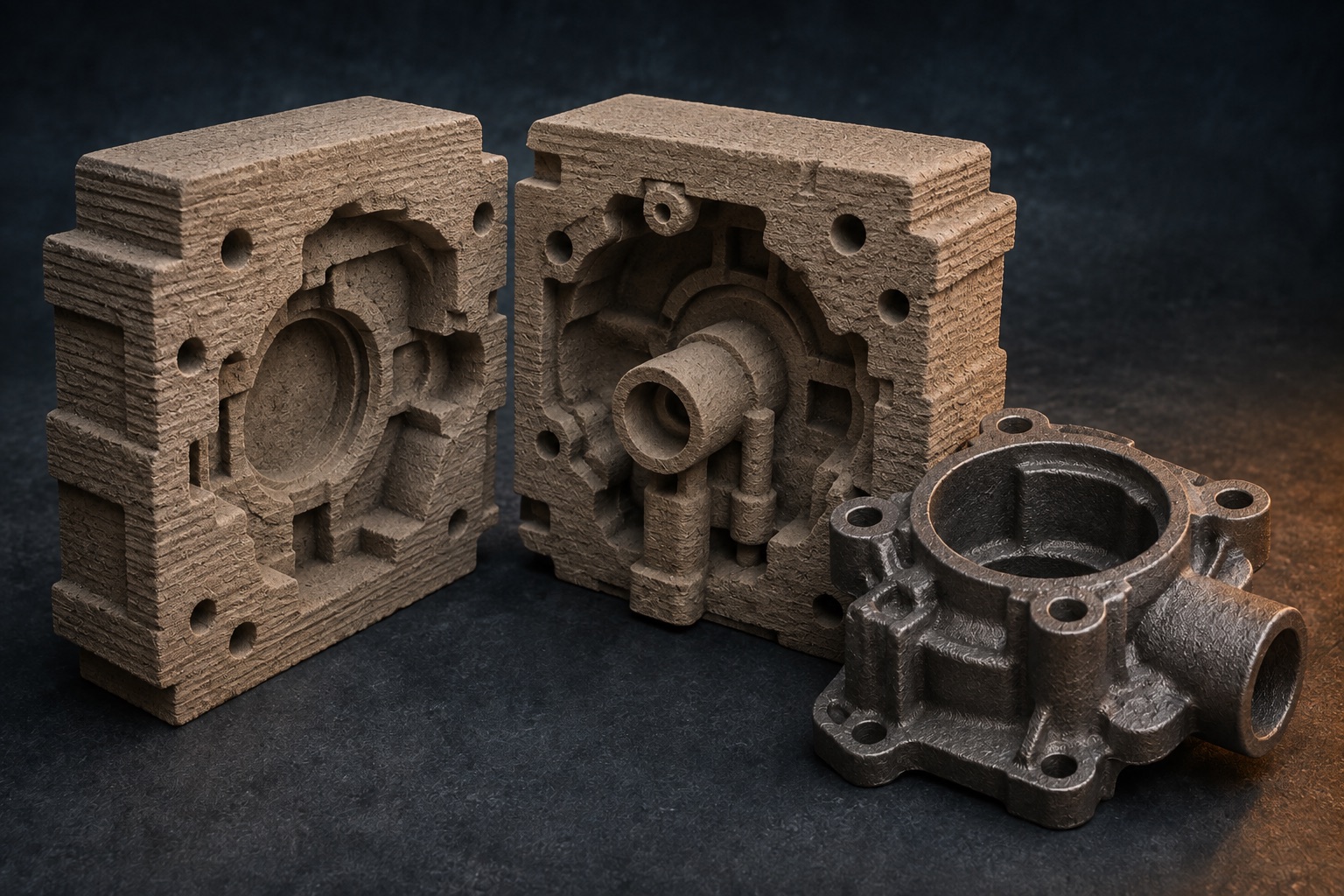
A FLEXIBLE SAMPLE ROUTE
Revise the sand mold while the design is moving.
3D-printed sand molds let the project explore cast parts and make design revisions before permanent production tooling. Machining and coating were included in the sample route so the customer could assess parts further along the intended manufacturing path.
Explore AMES manufacturing routesWHAT THE SEQUENCE ENABLED
A more informed tooling commitment.
The customer could begin assembly testing with CNC parts while AMES prepared cast-route samples in parallel. Both first machined parts passed CMM inspection. Early testing helped surface design issues and guided revisions before permanent tooling; the later sand-mold route supported further iteration ahead of the final drawing release.
Once the drawing was released, the project could proceed to production tooling, FAI and PPAP with physical learning already behind the design decisions.
HAVE A PART IN DEVELOPMENT?
Plan a route around your next decision.
Share the current drawing stage, intended process and next milestone with AMES.